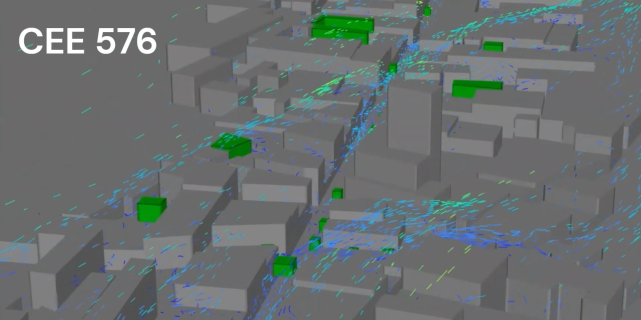
The course aims in the deeper and advanced comprehension of themeleiodon beginnings and applications of Environmental Reystomichanikis in multiple scales covering applications from the planitiki scale until local/mikroklimaka.
Particular indication through and relative work it becomes in the subject of cross-border transport of dust in Cyprus.
Learning Outcomes
• Fundamental understanding of environmental fluid dynamics in polyclimate problems (from planetary to urban and local scale)
• Ability to critically apply the basic principles to real environmental problems in fluid mechanics
Course Content
Introduction to environmental flows. A brief review of basic transport mechanisms in the aquatic and atmospheric environment (switching, molecular and turbulent diffusion, dispersion). Mix and disperse in two- dimensional systems. Law 4/3. Analytical solutions. Renewal time. Structured flows: basic concepts, Boussinesq approach. Layered flows, density currents. Veins. Characteristics of individual supraventricular veins, vein interaction, effect of environmental conditions. Elements of geophysical fluid mechanics: large-scale flows, effect of rotation of the earth. Ekman mattress.
Number of ECTS
8
Level of Course
3rd Cycle (Doctoral’s Degree)
Lectures/Week
1 (3 hours per lecture)
Prerequisites
Fluidmechanics (CEE270) and Transport Phenomena in Environmental Engineering (CEE483)
Co-requisites
Not Applicable
Teaching Methodology
Lectures (3 hours/week)
Assessment
Homework, Final exam.
Bibliography
Teachers’ notes.
STULL, R., METEOROLOGY FOR SCIENTISTS AND ENGINEERS
(Brookes/Cole) Second Edition
CSANADY, G.T.,, TURBULENT DIFFUSION IN THE ENVIRONMENT TURNER, J.S.,BUOYANCY EFFECTS IN FLUIDS C.U.P. 1973
TENNEKES, H. & LUMLEY, J. L , A FIRST COURSE IN TURBULENCE
MIT Press 1972